A working definition
Mobility capital is the accumulated capacity and resources through which individuals recognise, access and convert cross-border opportunities into valuable outcomes, while retaining meaningful choices about whether, when and how to move.Working definition used by Magellan Global. It extends an existing research lineage—Murphy-Lejeune (2002), Kaufmann, Bergman and Joye (2004) and Moret (2018, 2020)—and is not a new coinage.
Magellan Global positions itself as a researcher and applied developer of Mobility Capital: it builds on the existing literature, and it uses the design, data and enterprise outcomes of GSRP to make its own academic contribution.
The observation behind the framework is older than the term. The group’s name recalls the Magellan–Elcano expedition, and the story behind the name traces the same pattern from the Silk Roads to the first circumnavigation: people who travelled into unfamiliar markets brought home an understanding of where things came from, how people lived and what different markets valued—and that understanding could become the beginning of a new enterprise. The research literature makes the same point in modern terms. Physical presence, Moret finds, is often indispensable for learning about new opportunities, gathering information, drawing inspiration, expanding networks and creating trust—things that remote information cannot fully replace (Moret, 2020).
Mobility capital names the modern form of that stock. It is built by a successor running a project in another country, a researcher joining a laboratory abroad, a professional taking responsibility inside an unfamiliar regulatory system—and, as the next sections explain, it can begin with a visit, a short stay or an exchange, provided the experience is later converted into capability and choice.
Three components and one criterion
Knowledge
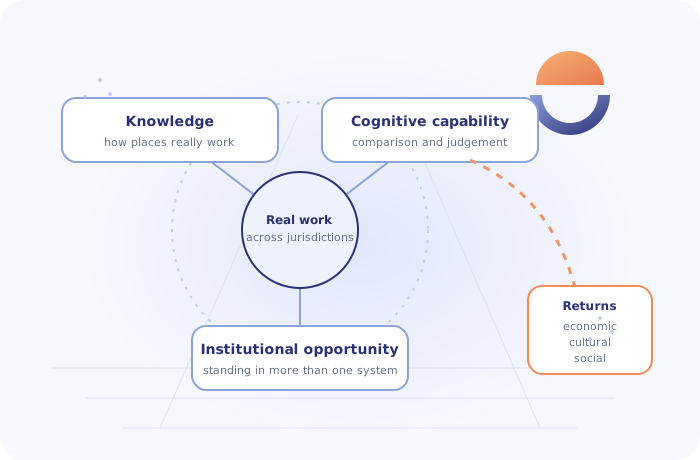
Practical knowledge, skills and an understanding of how other places work—what the literature describes as the accumulated experience of crossing borders. Magellan Global studies how AI, industry, enterprise-operations and institutional knowledge accumulate in that process.
Cognitive capability
Experience helps people read a situation and plan what to do next. Magellan Global studies how judgement, cognitive flexibility and opportunity recognition change through cross-border experience, using instruments from multicultural-experience and cultural-intelligence research.
Opportunity
The potential for future movement together with the legal, financial and social resources that make it real. Magellan Global studies how accessible markets, networks and institutional conditions are converted into actual choices.
A criterion that runs through all three. Following Moret, mobility capital is not measured by how much a person moves. It is measured by control over moving and staying, by local anchorage—the roots built in each place—and by the ability to convert resources between places (Moret, 2020). The framework therefore asks, of any experience, whether it increased the person’s autonomy while preserving the continuity of their family and enterprise. Knowledge without judgement becomes anecdote; judgement without opportunity cannot be acted on; opportunity without knowledge is a status, not a capital.
Conversion, returns and enterprise renewal
Bourdieu’s account of capital rests on convertibility: economic, cultural and social capital can be accumulated and exchanged for one another (Bourdieu, 1986). Moret shows that mobility capital works the same way in both directions—people invest their other resources to develop productive mobility practices, and then activate mobility capital to obtain resources in different places, transfer them and convert them to their advantage (Moret, 2020). The framework keeps that structure and asks what the returns look like for a successor and the enterprise behind them. Economic: a better process adopted at home, a new market entered, a supplier or partner secured. Cultural: the ability to operate credibly inside more than one institutional setting. Social: relationships useful to the person’s organisations, not only to the person.
The aggregate of those returns, when the person is a successor or key employee, is what the framework calls family-enterprise renewal: an existing business gaining the knowledge, judgement and connections it needs for its next stage through the people who will lead it. The literature also notes that mobility dispositions are transmitted within families—children raised in a transnational field develop knowledge and skills related to several contexts before they travel themselves (Moret, 2018)—which is one reason the framework treats the family and the enterprise together rather than the individual alone.
Presence, visits and work: how it is formed
The framework does not require long-term employment abroad. Moret’s respondents often identified a business or social project during a short visit—evaluating the local situation, assessing opportunities for work, business or investment—and then returned to their place of residence to acquire the skills and resources the project needed (Moret, 2020). Early experiences of mobility were rarely intended to be rewarding, yet they opened a window onto new opportunities and became a first step in accumulating mobility capital. Short stays, visits, research exchanges and work can therefore all be part of forming mobility capital. Whether an experience produces durable capability and real choices is the open question, and it is what the group’s programmes are designed to observe.
This is why the group’s offer runs from shorter international stays and experience programmes, coordinated by WG Global, to GSRP, in which real work, AI projects, mentor exchange and structured reflection are designed as the principal cultivation mechanisms so that their effects can be compared. It is also why the framework treats immigration substance—a real employer, real duties, real supervision, real pay—as a condition of the journey rather than its product: the same substance that authorities test for is what builds the capital, and compliance and capability are two sides of one thing.
It is also the point at which the framework separates from investment migration. Residence or citizenship acquired for capital is a status; it may widen access, but on its own it builds neither the skills that the literature calls savoir-circuler nor the local anchorage that lets a person benefit from mobility and stability at once (Moret, 2018). Mobility capital is a capacity, and like any capital it can also diminish when it is not maintained.
Research lineage
The concept has developed step by step over two decades, and the framework is placed explicitly inside that lineage.
- Forms of capital. Bourdieu distinguishes economic, cultural and social capital and argues that they are accumulated through invested time and converted into one another (Bourdieu, 1986). Every later use of “mobility capital” rests on this idea of accumulation and convertibility.
- Mobility capital for student travellers. Murphy-Lejeune introduces the term in her study of European students abroad, treating it as a component of human capital: the accumulated experience and disposition that make further mobility possible and let a person benefit from living in another country (Murphy-Lejeune, 2002, ch. 3).
- Motility: mobility as capital. Kaufmann, Bergman and Joye define motility as the capacity of a person to be mobile in social and geographical space, understood through three factors—access, skills and appropriation (the cognitive use of access and skills to realise projects)—and they include the option of non-action (Kaufmann, Bergman and Joye, 2004). Flamm and Kaufmann operationalise the concept and show that the subjective feeling of control over mobility comes from past experience and socialisation (Flamm and Kaufmann, 2006).
- Two facets of mobility capital. Moret, drawing explicitly on Bourdieu and on Kaufmann’s group, argues that mobility capital has two equally important facets: the accumulation of past experiences of crossing borders, through which people acquire technical and cognitive skills; and the potential for future movement—the unequally shared ability to move again when it is worthwhile, including the choice not to move. People with high mobility capital articulate local anchorage and mobility at the same time and control when and how they move. The concept applies to anyone, migrant or not, continues to develop after any initial move, and can diminish (Moret, 2020; Moret, 2018, ch. 3).
- Adjacent research on what experience does to people. Experiential-learning theory describes how experience becomes knowledge through reflection and application (Kolb, 1984); absorptive capacity explains why prior related knowledge determines what an organisation can recognise and use (Cohen and Levinthal, 1990); cultural intelligence and the multicultural-experience literature provide instruments for the cognitive side (Earley and Ang, 2003; Maddux and Galinsky, 2009).
How the framework maps onto the research
| Magellan Global component | Research basis it takes up | What Magellan Global continues to investigate |
|---|---|---|
| Knowledge | Cross-border experience forms practical knowledge, skills and an understanding of different places (Murphy-Lejeune; Moret’s first facet) | How AI, industry, enterprise-operations and institutional knowledge accumulate |
| Cognitive capability | Experience helps people read their situation and plan subsequent action (Kaufmann’s “appropriation”; Moret’s technical and cognitive skills) | How judgement, cognitive flexibility and opportunity recognition change |
| Opportunity | The potential for future movement, with legal, financial and social resources (Kaufmann’s “access”; Moret’s second facet) | How accessible markets, networks and institutional conditions become actual choices |
| Criterion across all three | Control over moving and staying, local anchorage, conversion of resources (Moret) | Whether autonomy increases while family and enterprise continuity is maintained |
References
- Bourdieu, P. (1986). The forms of capital. In J. G. Richardson (ed.), Handbook of Theory and Research for the Sociology of Education (pp. 241–258). Greenwood Press.
- Murphy-Lejeune, E. (2002). Student Mobility and Narrative in Europe: The New Strangers. Routledge. (Chapter 3 introduces “mobility capital” for student travellers.)
- Kaufmann, V., Bergman, M. M. and Joye, D. (2004). Motility: mobility as capital. International Journal of Urban and Regional Research, 28(4), 745–756. doi.org/10.1111/j.0309-1317.2004.00549.x ↗
- Flamm, M. and Kaufmann, V. (2006). Operationalising the concept of motility: a qualitative study. Mobilities, 1(2), 167–189. doi.org/10.1080/17450100600726563 ↗
- Moret, J. (2018). European Somalis’ Post-Migration Movements: Mobility Capital and the Transnationalisation of Resources. IMISCOE Research Series, Springer (open access). Chapter 3, “Mobility: A Practice or a Capital?” doi.org/10.1007/978-3-319-95660-2 ↗
- Moret, J. (2020). Mobility capital: Somali migrants’ trajectories of (im)mobilities and the negotiation of social inequalities across borders. Geoforum, 116, 235–242 (first published online 2017). doi.org/10.1016/j.geoforum.2017.12.002 ↗
- Kolb, D. A. (1984). Experiential Learning: Experience as the Source of Learning and Development. Prentice Hall.
- Cohen, W. M. and Levinthal, D. A. (1990). Absorptive capacity: a new perspective on learning and innovation. Administrative Science Quarterly, 35(1), 128–152.
- Earley, P. C. and Ang, S. (2003). Cultural Intelligence: Individual Interactions Across Cultures. Stanford University Press.
- Maddux, W. W. and Galinsky, A. D. (2009). Cultural borders and mental barriers: the relationship between living abroad and creativity. Journal of Personality and Social Psychology, 96(5), 1047–1061.
- Brynjolfsson, E., Li, D. and Raymond, L. (2025). Generative AI at work. The Quarterly Journal of Economics, 140(2), 889–942. doi.org/10.1093/qje/qjae044 ↗
- Dell’Acqua, F., McFowland III, E., Mollick, E., Lifshitz-Assaf, H., Kellogg, K., Rajendran, S., Krayer, L., Candelon, F. and Lakhani, K. R. (2023). Navigating the jagged technological frontier: field experimental evidence of the effects of AI on knowledge worker productivity and quality. Harvard Business School Working Paper 24-013. aiinstitute.hbs.edu/navigating-the-jagged-technological-frontier/ ↗
The reading list is indicative, not a systematic review. The research programme’s own literature review, instruments and findings will be published through MTRI and in peer-reviewed venues as they become available.
What is established, and what Magellan Global adds
Three things are already in the literature and are not claimed as new: that cross-border experience builds technical and cognitive skills; that mobility capital converts into and out of other forms of capital; and that the option of future movement is itself part of the capital. The group’s contribution has to be more specific than “adding cognition and opportunity”. The question Magellan Global proposes to study is this:
Which cross-border experiences and learning arrangements develop which capabilities—and under what conditions do those capabilities convert into outcomes for successors, families and enterprises?The research question behind GSRP.
GSRP is designed to answer it. Real work, AI projects, mentor exchange and structured reflection are its principal cultivation mechanisms, and the programme compares their effects rather than asserting in advance that one of them is decisive. That is a more defensible claim than “only real work produces mobility capital”, it is consistent with the literature’s finding that visits and short stays can start the process, and it is open to academic testing. The results, positive or negative, are what the group intends to publish.
Mobility Capital in the age of AI
As AI expands what people can do, knowledge, judgement and access to meaningful opportunities become increasingly important. Magellan Global’s Mobility Capital framework explores how cross-border experience can develop these resources—and help people turn AI capability into enterprise value.Magellan Global’s research proposition for the AI era.
AI has widened the range of work a person can complete. Knowledge, experience and judgement then decide whether that person chooses the right question, recognises an error and converts an output into something of value. The difference is easiest to see in the questions people ask. Consider the same business problem approached by two people with different levels of first-hand understanding:
| Experience and understanding | The question put to AI |
|---|---|
| Has not yet seen how the client actually operates | “How can we use AI to increase our company’s revenue?” |
| Has worked on site with a client in Japan and found that deals stall in security review and delivery acceptance | “Using these interview notes and process records, analyse the causes of review delay; compare a knowledge base, document pre-checks and manual review; and list the data, cost and validation metrics each would need.” |
The second question is valuable because the person asking it has been present, understands the constraints and knows which result is worth pursuing. AI can carry out the analysis; the person is in a position to check whether it matches reality. This is the capability that cross-border experience—when it is converted into mobility capital—is proposed to develop.
The claim has to be stated carefully, because the evidence on AI and expertise cuts both ways. A field study of customer-support work found that generative AI raised productivity most for less experienced and lower-performing workers, by making part of expert practice available to novices (Brynjolfsson, Li and Raymond, 2025); so experience is not a precondition for benefiting from AI, and good interface and process design lower the threshold. A field experiment with 758 consultants, on the other hand, found that AI improved speed and quality on tasks inside its capability frontier while people who relied on it for tasks outside that frontier performed worse than those without it (Dell’Acqua et al., 2023). Knowing when to use AI, how to check it and when other evidence is needed is therefore the capability that matters—and it is the one the framework’s three components describe.
| Mobility Capital component | Its possible role in using AI |
|---|---|
| Knowledge | Supplies the background, vocabulary, constraints and evidence that make a question substantive |
| Cognitive capability | Compares explanations, challenges assumptions, verifies outputs and decides the next step |
| Opportunity | Gives access to problems worth solving, collaborators, data and the settings in which a solution can be implemented |
Opportunity carries particular weight here. Even a person who can get an excellent analysis from AI still needs client access, enterprise authority, data and a working network to turn that analysis into an outcome. GSRP’s development goal follows from this: participants should become progressively able to find the problem, organise the evidence, direct AI, verify the result and complete a change inside a real enterprise. Cross-border work and exchange provide the different situations; MTRI provides the research perspective; AKE and AwePlus provide the tools and implementation support.
Does Mobility Capital improve the ability to create value with AI?The research question for the AI era. Proposed mechanism: cross-border experience and reflection → situational knowledge and problem definition → quality of AI use and verification → project outcomes.
Two limits are stated with the proposition. Whether cross-border experience adds anything beyond equally intensive local work and training is a comparative question that the programme is designed to test, not assume. And the AI studies cited above establish the two ends of the mechanism—that AI changes what people can do, and that judgement decides whether the result is right—not the full chain through mobility capital. That chain is what Magellan Global intends to study with its own data.
How the framework is used across the group
Mobility Capital is one of the four pillars that explain how Magellan Global’s brands fit together, alongside AI, professional services and AKE. Each brand contributes to one or more of the three components.
 Magellan Global
Researcher and applied developer of the framework; operates GSRP, in which real work, AI projects, mentoring and reflection are the designed cultivation mechanisms. GSRP ↗
 MTRI
Carries the doctoral research programme and its measurement work, including cultural-intelligence scales and integrative-complexity coding, as the group’s de facto non-profit research institution. MTRI ↗
 WG Global
Assesses routes on the three returns, plans them in sequenced stations across nine destinations, and designs the shorter international stays and experience programmes through which mobility capital can begin to form. Mobility Capital at WG Global ↗
 AwePlus
Provides the enterprise AI projects in which GSRP participants apply what they learn, so that knowledge gained abroad becomes implementation at home. AwePlus ↗
 magellon
Connects exceptional professionals with cross-border work opportunities—the opportunity component, made visible. magellon ↗
 ABAE
Explains international education in a U.S. context, so that credentials earned in one system are recognised in another. ABAE ↗
 AJPE
Supports the family side of a cross-border journey through school admissions and educational experiences—the intergenerational transmission the literature describes. AJPE ↗
The research programme and what we do not claim
The framework is the subject of a doctoral research programme led by the founder of Magellan Global and conducted with MTRI. The programme draws on the mobility-capital literature above, multicultural-experience psychology, absorptive-capacity theory, real-options reasoning and the sociology of capital, and uses established instruments where they exist. A prevalence study and a family of Mobility Capital indices are planned; their methodology will be published before any index is.
Three boundaries are stated plainly. Magellan Global did not coin the term and builds on the authors cited here, none of whom has reviewed or endorsed GSRP. The framework is proposed, not proven: it informs programme design until findings are published. And Magellan Global and its brands have a commercial interest in services that build mobility capital, so the research is designed with that interest disclosed—independent co-authors, third-party data collection where participants are involved, and publication of results whether or not they support the framework. Nothing here is a promise of a measured outcome, a job, a promotion, an investment return or an immigration result for any individual.
Questions
What is Mobility Capital?
Working definition used by Magellan Global, extending existing research: Mobility capital is the accumulated capacity and resources through which individuals recognise, access and convert cross-border opportunities into valuable outcomes, while retaining meaningful choices about whether, when and how to move. Mobility capital was first developed in the study of student mobility (Murphy-Lejeune, 2002), in the motility framework (Kaufmann, Bergman and Joye, 2004) and in Joëlle Moret’s research on post-migration mobility (2018, 2020).
Who developed the concept, and what does Magellan Global add?
The concept belongs to an established research lineage: Bourdieu’s forms of capital; Murphy-Lejeune’s mobility capital for student travellers (2002); Kaufmann, Bergman and Joye’s motility, mobility as capital (2004); and Moret’s two facets of mobility capital, accumulated past experience and the potential for future movement (2018, 2020). Magellan Global does not claim to have invented the term. It proposes an applied framework centred on knowledge, cognitive capability and opportunity, and, through GSRP, seeks to investigate how these resources develop and contribute to family-enterprise renewal. None of the cited authors has reviewed or endorsed GSRP.
Does Mobility Capital require long-term employment abroad?
No. The research shows that physical presence is often indispensable for learning about opportunities, gathering information, drawing inspiration, expanding networks and creating trust, and that short visits can be the moment at which a person identifies a business or social project and then returns home to acquire the skills and resources it needs. Short stays, visits, research exchanges and work can all be part of forming mobility capital. Whether an experience produces durable capability and real choices is what has to be observed, and GSRP structures real work, AI projects, mentoring and reflection as its principal cultivation mechanisms so that their effects can be compared.
How is Mobility Capital different from citizenship or residence by investment?
Investment migration exchanges capital for a residence or citizenship status. Mobility capital is a capacity: accumulated experience, skills and resources that let a person recognise, access and convert cross-border opportunities, together with the option to stay, move or move again. A status may widen access, but on its own it builds neither the skills nor the local anchorage the research describes.
What are the three components of Magellan Global’s framework?
Knowledge: the practical understanding of how another place produces, trades, regulates and organises work, including AI, industry, enterprise-operations and institutional knowledge. Cognitive capability: judgement, cognitive flexibility and opportunity recognition developed through experience. Opportunity: the legal, financial, social and institutional conditions that can be converted into real choices. A cross-cutting criterion runs through all three: whether the person gains autonomy over moving and staying while keeping local anchorage and the continuity of family and enterprise.
How does Magellan Global apply the framework?
Through GSRP, the Global Successor Residency Program, which treats real work, AI projects, mentor exchange and reflection as cultivation mechanisms and compares their effects; through WG Global, which assesses and coordinates the mobility and compliance side and designs shorter international stays and experience programmes; and through MTRI, the group’s research institution, which carries the research programme and its instruments.
Why does Mobility Capital matter more as AI spreads?
As AI expands what people can do, knowledge, judgement and access to meaningful opportunities become increasingly important: they decide whether a person can choose the right question, recognise errors and turn an AI output into real value. Magellan Global’s framework explores how cross-border experience can develop these resources and help people turn AI capability into enterprise value. The group treats this as a research question—whether mobility capital improves the ability to create value with AI—rather than an established result.
Is Mobility Capital a guaranteed outcome?
No. The framework informs programme design and the research agenda. It is not a promise of a measured outcome, a job, a promotion, an investment return or an immigration result for any individual, and the research literature itself notes that mobility capital can diminish as well as grow.