YSRP · Outcomes pack
Take the finished project to ISEF-affiliated fairs, open-hardware robotics competitions and a first publication—and, for research that has matured, towards the highest goals.
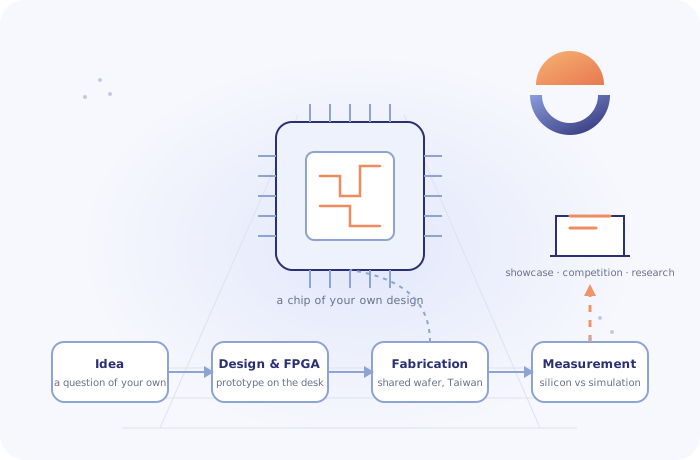
What we help you do
- 01
Map the competitions and venues that fit the project, the student’s age, where they study and the fabrication calendar: the regional ISEF-affiliated fair as the main line; WRO Future Innovators, WRO Future Engineers or RoboCupJunior Rescue Maze by project; a student journal or open-hardware conference for a first paper.
- 02
Prepare the measurements, analysis and report after the silicon returns, in the format the chosen venue requires—with the student writing the plan, abstract and poster themselves, as the 2027 ISEF rules require.
- 03
Rehearse judging questions, complete each venue’s forms and disclosures accurately, and assess whether the work is ready for the research track towards ISEF-level awards or a professional venue such as FPGA, DAC or ICCAD.
What the engagement produces
- A competition-ready project report and display materials.
- A manuscript submitted to a student journal or an open-hardware conference.
- A record of entries, results and feedback for the family and, with consent, for the group’s published cohort figures; and, where warranted, a written assessment for the research track.
How it works
Choose the venues with the mentor during the programme, after checking eligibility where the student studies.
Five hours of writing guidance and four hours of competition preparation after the chip returns.
Submission support, introductions to independent special awards for custom-silicon projects, and a review for the research track where the work justifies it.
Your questions, answered.
Do you guarantee a result?
No. We support entries and submissions and publish each cohort’s participation and acceptance figures once they exist. Awards and acceptances depend on the student and the venue.
Which venues are the highest goals?
Regeneron ISEF above all, with Regeneron STS, EUCYS, the Yau Science Award and Davidson Fellows where eligible; WRO Future Innovators, WRO Future Engineers and RoboCupJunior Rescue Maze among robotics competitions; and FPGA, DAC, ICCAD or ICRA for the rare mature paper. The outcomes page lists eligibility and achievement levels for each.
What is the research track?
Continued mentoring for the few projects that have become real research, aimed at ISEF-level awards or a professional venue. It is scoped and priced per project after a review of the work.
Make it relevant to you.
Tell us the student’s age, interests and location. We will confirm the next cohort.